


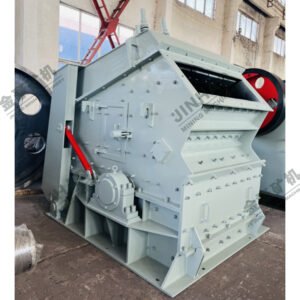

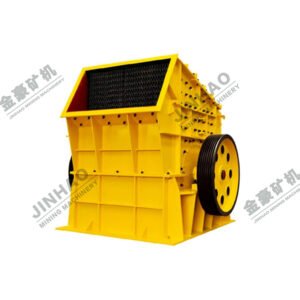

| Technical Data Sheet of PF Impact Crushers | ||||
| Model | Specification | Feeding Size(mm) | Processing Capacity(t/h) | Motor Power(kw) |
| PF-0504 | φ500×400 | 100 | 5–8 | 7.5 |
| PF-0607 | φ600×700 | 120 | 10–20 | 30 |
| PF-1007 | φ1000×1050 | 250 | 15–30 | 37 |
| PF-1010 | φ1000×1050 | 250 | 30–80 | 75 |
| PF-1210 | φ1250×1050 | 300 | 60–120 | 110 |
| PF-1214 | φ1250×1400 | 300 | 80–160 | 132 |
| PF-1315 | φ1320×1500 | 300 | 100–180 | 200 |
| PF-1320 | φ1320×2000 | 300 | 150–250 | 280 |
| PF-1515 | φ1500×1500 | 350 | 180–280 | 315 |
| PF-1520 | φ1500×2000 | 350 | 200–320 | 350 |
Product Features
The PF impact crusher is configured as a secondary crusher after the primary crusher. It is suitable for crushing ores and rocks with a compressive strength not exceeding 320 MPa. The impact crusher utilizes the high-speed impact force of the rotor to break materials. The final products feature excellent grain shape, with a cubic content of over 90% and fewer needle-like particles. It has a large crushing ratio and can complete both primary and secondary crushing in one step, with a processing capacity ranging from 30 to 800 tons per hour. The structure is simple, discharge size is easy to adjust, and the wear-resistant blow bar offers long service life. It is suitable for processing medium-hard and softer ores, making it the preferred equipment for producing high-quality aggregates used in high-grade highways, water conservancy projects, airports, and construction industries.
Selection Guidelines
-Material Properties: Select an appropriate model based on the hardness, moisture content, particle size, and clay content of the feed material, in order to avoid excessive wear or blockage caused by unsuitable materials.
-Production Requirements: Match the crusher’s feed opening size, capacity, and discharge size with the plant’s processing capacity, product size requirements, and technological process.
-Operation & Maintenance: Consider the service life of wear parts, maintenance costs, and ease of inspection and repair to ensure stable production while minimizing operating expenses.


